

From Data Overload to Strategic Advantage: Making Metrics Meaningful
Effective metrics monitoring transforms raw payment data into strategic business intelligence that guides decision-making, reveals optimization opportunities, and supports sustainable growth. The key lies in focusing on meaningful indicators rather than tracking everything possible.
Essential Metrics That Drive Business Decisions
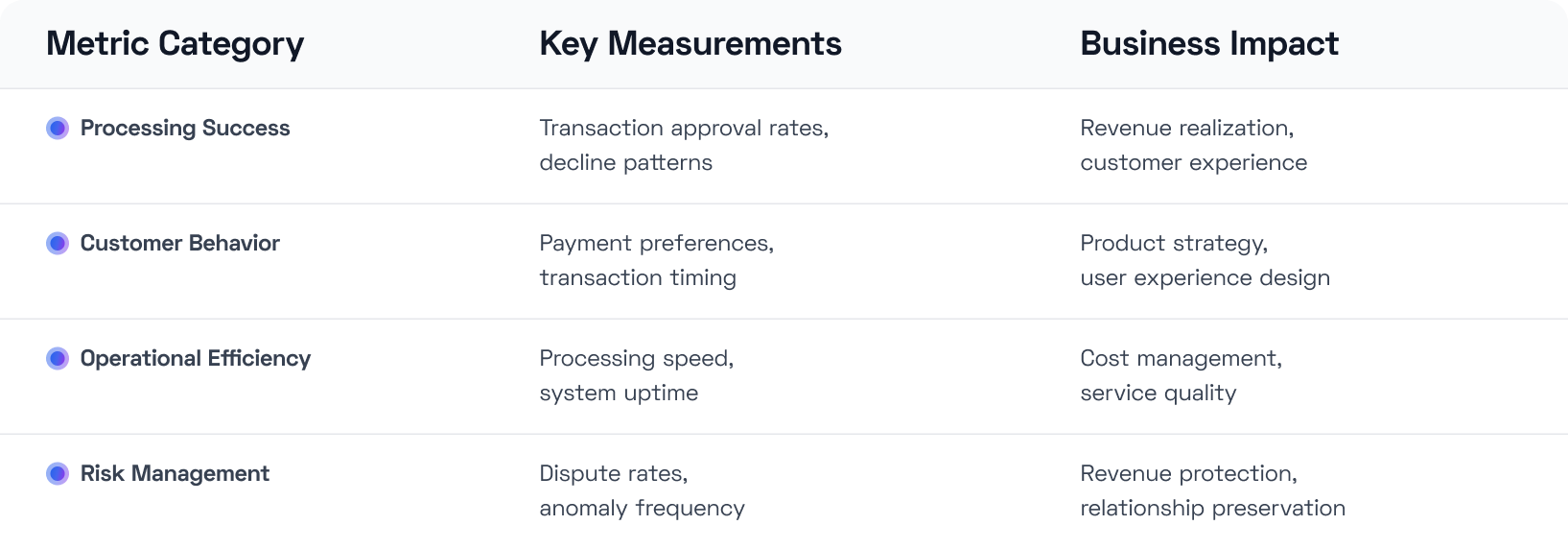
Turning Numbers Into Insights
Rather than simply collecting data, successful metrics monitoring starts with specific business questions that drive focused analysis and actionable outcomes.
Strategic Business Questions:
→ Which payment methods provide the best customer experience?
→ When do customers prefer to complete transactions?
→ Where are we losing potential revenue in the payment process?
→ How do different customer segments behave during checkout?
→ What patterns indicate emerging problems or opportunities?
Insight Development Process:
- Identify Business Decisions - Determine what decisions require data support
- Select Relevant Metrics - Choose indicators that provide decision-relevant information
- Analyze Patterns - Examine trends within business context and objectives
- Translate Findings - Convert analysis into actionable recommendations and strategies
- Monitor Results - Track implementation outcomes to validate insights and refine analysis
Advanced Analytics for Deeper Understanding
Basic metrics provide foundation insights, but advanced analytical techniques reveal deeper patterns that drive competitive advantages. These techniques help businesses understand not just what happened, but why it happened and what might happen next.
Advanced Analytical Approaches:
- Cohort analysis that tracks customer behavior evolution across different time periods
- Regression analysis that identifies factors most strongly correlated with desired outcomes
- Trend forecasting that predicts future performance based on historical patterns
- Comparative analysis that benchmarks performance against previous periods or segments
- Correlation studies that reveal unexpected relationships between different business metrics
Creating Actionable Intelligence
Performance Optimization Strategies:
Customer Experience Enhancement:
- Identify friction points in payment processes that reduce conversion
- Understand payment method preferences across different customer segments
- Recognize optimal timing for payment communications and offers
- Detect regional variations that require localized payment strategies
Operational Improvement:
- Monitor processing performance to identify system optimization opportunities
- Track transaction success rates across different channels and methods
- Analyze customer support patterns related to payment issues
- Measure fraud prevention effectiveness on legitimate transactions
Revenue Growth Support:
- Identify customer segments with highest transaction values and frequencies
- Understand seasonal patterns that affect payment volumes and preferences
- Recognize cross-selling opportunities based on payment behaviors
- Track payment improvement impact on overall business performance
Contextual Metrics Framework
Individual metrics become meaningful when viewed within appropriate business context. Contextual frameworks help interpret metrics accurately while avoiding misleading conclusions from isolated data points.
Context Consideration Factors:
→ Seasonal variations that naturally affect transaction patterns and volumes
→ External events that influence customer behavior and payment preferences
→ Business changes that impact operational performance and customer experience
→ Market conditions that affect industry-wide payment patterns and behaviors
→ Customer lifecycle stages that influence engagement levels and transaction characteristics
Implementation Best Practices
Start with clear business objectives that define what success looks like for your metrics monitoring program. Objectives should be specific, measurable, and aligned with overall business strategy.
Focus on metrics that directly influence business decisions rather than tracking everything possible. Too many metrics can create analysis paralysis and reduce focus on important indicators.
Establish regular review cycles that ensure insights translate into action. Metrics monitoring without action planning provides limited business value.
Organizational Alignment for Metrics Success
Metrics monitoring effectiveness depends on organizational alignment around measurement objectives and action planning. Successful programs ensure that relevant stakeholders understand metrics significance and commit to acting on insights.
Alignment Strategy Elements:
- Stakeholder education about metrics importance and interpretation methods
- Communication processes that share insights with appropriate decision makers
- Responsibility assignment for acting on metrics findings and recommendations
- Resource allocation that enables implementation of metrics-driven improvements
- Success measurement approaches that track metrics program effectiveness
Continuous Improvement Through Metrics Evolution
Effective metrics programs evolve continuously as business needs change and analytical capabilities improve. Evolution processes ensure that metrics remain relevant and valuable for decision-making.
Evolution Approaches:
· Regular metrics relevance assessment that identifies outdated or unnecessary indicators
· New metrics development that addresses emerging business questions and challenges
· Analytical technique enhancement that improves insight quality and accuracy
· Technology upgrade planning that maintains competitive analytical capabilities
· Best practice integration that incorporates industry advances and innovations
Competitive Intelligence Integration
Metrics monitoring becomes more powerful when combined with competitive intelligence that provides industry context for internal performance evaluation. Competitive insights help businesses understand relative performance levels and identify improvement opportunities.
Competitive Analysis Elements:
· Industry benchmark comparison that reveals relative performance strengths and weaknesses
· Best practice identification that suggests improvement strategies and techniques
· Market trend analysis that anticipates future challenges and opportunities
· Innovation monitoring that identifies emerging technologies and approaches
· Performance gap analysis that prioritizes improvement initiative development
Conclusion
Strategic metrics monitoring transforms data complexity into business clarity, enabling informed decisions that drive growth and operational excellence.